

The ₹36 Lakh Lesson: Winning 70%, Losing Everything
Small wins, giant losses, and one very expensive vote.
I won 70% of my trades.
I also lost ₹36 lakh.
Both of these are true, and if that sentence doesn't scare you, keep reading. It should.
The receipt
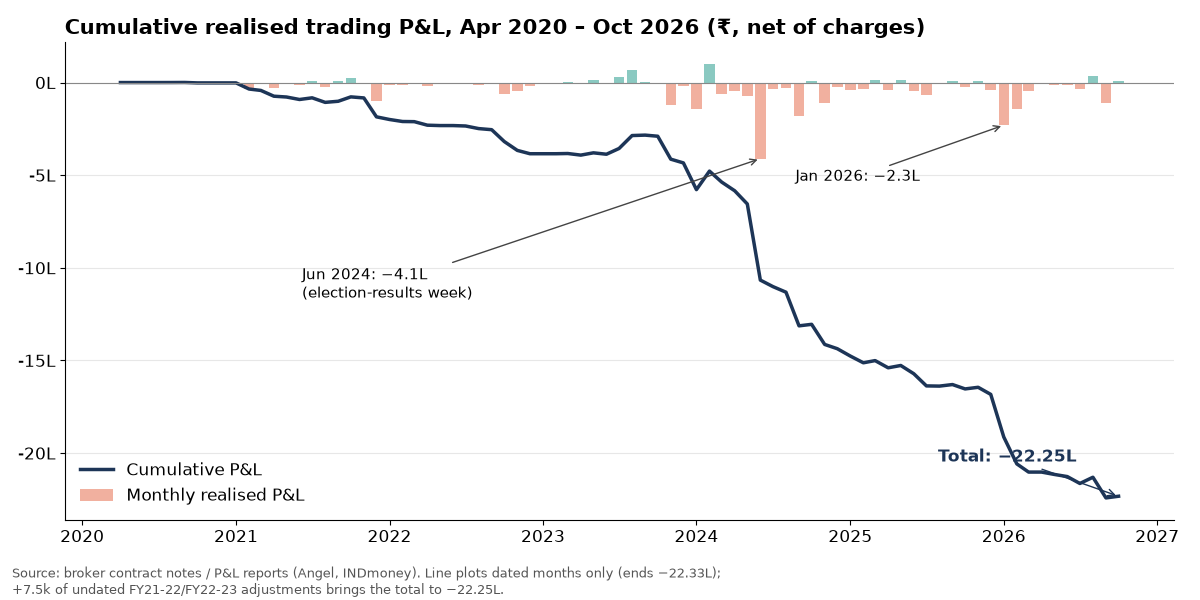
Since 2020 I've lost about ₹22.25 lakh trading. Add the interest and fees on the loans I took to keep trading, and the bill comes to roughly ₹36 lakh. That's about a third of everything I've taken home since 2022.
Fun fact: my running total peaked at ₹944, in September 2020. That was my all-time high. I've been "about to get back to it" ever since.
It started small. That was the trap.
Year one: −₹42,000. Felt like tuition.
The next three years: about −₹1.5 to ₹1.7 lakh, every single year. Never a disaster, never a winning year either. Just a steady, polite drip.
Small losses don't scare you. They train you. They teach you that losing is normal and winning it back is the job.
Winners are small. Losers are account cleaners.
I pulled all 2,969 trades into one sheet. The pattern took about four seconds to see:
- Average win: ₹1,186
- Average loss: ₹5,202
- Best trade ever: +₹20,437
- Worst trade ever: −₹2,44,622
Read that again. My worst trade was twelve times my best.
I had good months. Some were genuinely great. They just never lasted long enough to matter:
| Year | The good bit | The bill |
|---|---|---|
| FY 2023-24 | Jul–Aug 2023: +₹88,097 | Oct–Nov 2023: −₹1,16,172 |
| FY 2023-24 | Feb 2024: +₹99,867 | Jan 2024: −₹1,44,183 |
| FY 2024-25 | Both winning months: +₹18,722 | June 2024 alone: −₹4,08,520 |
| FY 2025-26 | Three winning months: +₹40,396 | Jan–Feb 2026: −₹3,73,667 |
| FY 2026-27 | Aug 2026: +₹33,686 | Sep 2026: −₹1,11,596 |
My winning months were applause. My losing months were the eviction notice.
June 2024: my election-day masterstroke
Every great disaster needs a great plan, and mine was democracy.
The 2024 general election results were landing in the first week of June. Every TV panel had a prediction. Every uncle had a theory. I had something better: a BANKNIFTY call option and the unshakable confidence of a man who had never been right about anything at this scale.
The world's largest democracy was about to speak. I was going to vote with my margin.
Reader, democracy did not consult my position.
On 5 June that one call lost ₹1,62,298. Over three days, about ₹3.4 lakh. June 2024 closed at −₹4,08,520, which is still my worst month and about 22 times everything I won in that year's good months.
Millions of Indians voted that week, and most of them did it for free. Mine cost four lakh rupees and I didn't even get the ink on my finger.
The lesson under the joke: a big, scheduled event is not an edge. Everyone knows it's coming, the options are already priced for it, and the only thing you bring is your own certainty. Certainty is the most expensive thing I've ever bought.
Options did the cleaning
Here's the part I'd tattoo on every new trader if they'd let me.
Options lost me about ₹21.6 lakh. That's 93% of everything. All my stock trading put together (intraday, delivery, US stocks) was down about ₹61,000. Delivery on its own was basically flat.
And options were where I looked most like a genius. My options win rate went up every year:
- FY 2023-24: 75%
- FY 2024-25: 83%
- FY 2025-26: 85%
- This year: 89%
Meanwhile my average options loss went from about ₹8,600 to more than ₹20,000.
I was getting better at winning and much, much better at losing. FY 2024-25 is the proof: I won 83% of my options trades and still lost ₹9.6 lakh.
Three numbers settle it:
- January 2026: one NIFTY call lost ₹2,44,622. That's about 160 typical wins, gone in one trade. Four weeks later, same strike, next expiry: another −₹1,75,730.
- My ten worst options trades lost ₹11.9 lakh, more than half of my lifetime loss.
- All 1,337 winning options trades made about ₹20 lakh. The losers took ₹41 lakh.
I wasn't trading. I was picking up coins in front of a steamroller and calling it a strategy.
Why a smart person does something this dumb
This isn't a markets story. It's a wiring story.
I'm a PhD scholar. My whole life has been training to win: exams, interviews, papers. Losing feels like a mistake you aren't allowed to make. So when a trade went against me, I didn't close it. I waited. It usually came back, I banked another tiny win, and my brain filed it under "see, you were right."
A high win rate is the most dangerous drug in trading, because it pays you to hold on.
Then one day it doesn't come back. And because you've been right so often, the loss doesn't feel like a signal. It feels like a typo. So you trade bigger to fix the typo.
That's revenge trading. It doesn't feel like revenge from the inside. It feels like correcting the record.
Then I borrowed to keep playing
FY 2024-25 is where it went from a hobby to a crisis: −₹9.6 lakh in one year, more than the previous four years combined.
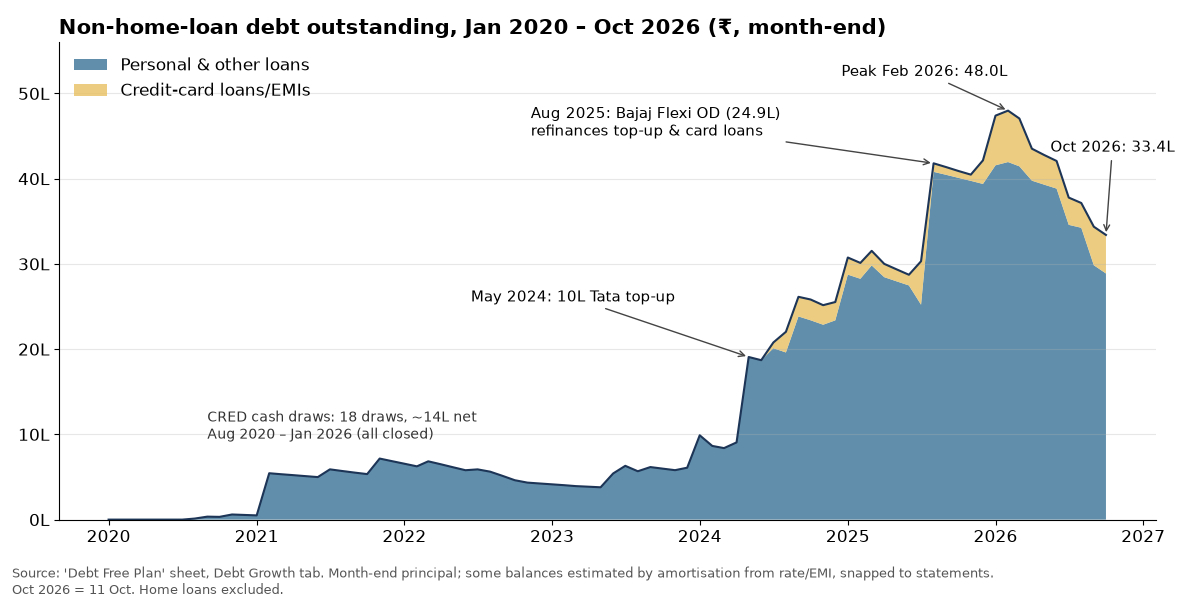
In 2024 I took a ₹10 lakh top-up loan to clear card bills and app loans. Over the next two years I drew on an app credit line 18 times, about ₹14 lakh in all. I named those draws myself, and honestly the names are better writing than anything in this post:
Loss. Loss Again. Loss Cover. Deficit May Month.
When your loan names read like a tragedy in four acts, you are not investing. You're funding a sequel.
The bottom
In August 2025 I took a ₹25 lakh overdraft to consolidate everything. About ₹18 lakh did its job and cleared older loans. Within two weeks, about ₹2.5 lakh of what was left was back in my trading account.
The lifeboat went straight back into the sea.
By February 2026, my debt outside the home loan peaked at about ₹48 lakh, spread over roughly 57 loans and credit lines since 2020. Many of them existed only to pay off the one before.
The climb
No dramatic epiphany. Just a spreadsheet that refused to lie to me.
Everything now lives in one sheet with a month-by-month payoff plan. Here's the scoreboard:
- Losses are down. This year so far: about −₹1.3 lakh. Still red, but no longer a fire.
- Debt is down. Non-home debt has fallen from about ₹48 lakh to about ₹33 lakh. Every app credit line is closed, along with several personal and fintech loans, two card loans and a loan against securities.
- The boring fixes are done. I moved my home loan from 9.4% to 7.4% interest, and I pay every card statement in full.
The target: bring my monthly EMIs and interest, about ₹1.78 lakh today, under ₹1 lakh, so only the home loan is left.
The plan, which is deliberately unexciting:
- Let the small card EMIs die of natural causes through 2027 and early 2028.
- Use a lump sum expected in January 2027 to kill the most expensive loan, a 14% flexi loan, which frees about ₹26,000 a month.
- Clear the bank personal loan next, then repay a friend who lent to me when it mattered.
If it holds, I'm under ₹1 lakh a month around March 2028. My goal is literally called Debt Free by 2027. The spreadsheet says 2028. For once, I'm going with the spreadsheet.
If you remember one thing
Your win rate is a vanity metric. Your average loss is the truth.
- If your losses are many times your wins, one bad week will erase a good year. Every time.
- A big event isn't an edge. It's a crowded room with a very expensive door.
- Never borrow to trade. Never, ever borrow to cover a trading loss.
- If you catch yourself naming a loan after a loss, stop. That name is your last honest warning.
I'm not out yet. But for the first time in six years, the line on the chart is moving the right way, and I'm not the one holding the steamroller's coins anymore.